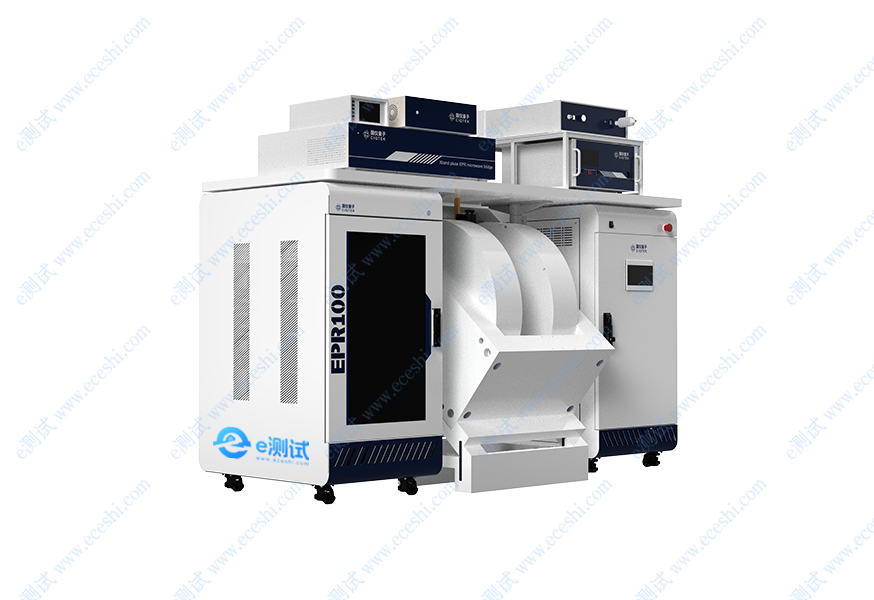
)
Pulsed EPR is widely used in materials science, chemistry, physics, catalysis, energy materials, semiconductor research, quantum materials, and biological systems.
By varying pulse sequences, magnetic-field conditions, and experimental parameters, Pulsed EPR can provide information about:
electron spin states, spin-spin interactions, spin-lattice relaxation, spin-spin relaxation, hyperfine interactions, electron-nuclear interactions, distances between paramagnetic centers, local molecular environments, spin dynamics and coherence
The technique is particularly useful for studying paramagnetic centers that contain unpaired electrons, including transition-metal ions, organic radicals, defects, and other spin-active species.
Pulsed EPR/ESR Testing Services: spin relaxation measurements, electron spin echo measurements, electron spin echo envelope modulation (ESEEM), electron-electron double resonance (ELDOR/PELDOR), hyperfine interaction analysis
Contact us to discuss your Pulsed EPR/ESR testing requirements, sample characteristics, target parameters, and experimental objectives.